
Additional Menu

The following statements are based on Elsevier recommendations and the Committee on Publication Ethics (COPE) Best Practice Guidelines for Journal Editors.
Jurnal Manajemen Transportasi & Logistik (JMTRANSLOG), published by Institut Transportasi dan Logistik Trisakti (ITL Trisakti) in collaboration with Asosiasi Logistik Indonesia (ALI), is committed to upholding the highest standards of publication ethics and follows the principles and guidance of the Committee on Publication Ethics (COPE).
JMTRANSLOG is committed to maintaining the integrity of the scholarly publishing process and taking appropriate measures against publication malpractice. By submitting a manuscript, authors confirm that their work is original, has not been published previously, and is not under consideration for publication elsewhere. Authors must ensure that their manuscripts do not contain plagiarism, in whole or in part, and that all sources have been properly acknowledged. Authors must also disclose any actual or potential conflicts of interest and all relevant sources of financial support.
The Editor-in-Chief is responsible for deciding which submitted manuscripts should be published in JMTRANSLOG. Editorial decisions are guided by the journal's editorial policies, the academic quality of the manuscript, reviewers' recommendations, and applicable legal requirements concerning defamation, copyright infringement, and plagiarism. The Editor-in-Chief may consult other editors or reviewers when making publication decisions.
The editorial team conducts an initial assessment of each manuscript to evaluate its suitability for the journal's aims and scope, compliance with the author guidelines, and originality. Appropriate tools may be used to assist in checking the originality of submitted manuscripts. Manuscripts that pass the initial screening are forwarded to a minimum of two reviewers for double-blind peer review. Reviewers evaluate the manuscript and recommend whether it should be accepted, revised, or rejected.
The review process generally takes approximately 2–4 weeks, depending on reviewer availability and the complexity of the manuscript. The overall period from submission to publication is estimated at approximately 8–12 weeks, depending on the review outcome, the extent of revisions required, the authors' response time, and the production schedule. These periods are estimates and may vary between manuscripts.
Unpublished materials disclosed in a submitted manuscript must not be used by editors or other individuals who have access to the manuscript in their own research without the author's express written consent. Editors must disclose any conflicts of interest and refrain from handling manuscripts where such conflicts could compromise impartiality.
Manuscripts must be evaluated solely on their intellectual and scholarly merit, without discrimination based on authors' race, gender, sexual orientation, religious beliefs, ethnic origin, citizenship, or political philosophy.
The Editor-in-Chief, editors, and editorial staff must maintain the confidentiality of submitted manuscripts. Information about a manuscript must not be disclosed to anyone other than the corresponding author, reviewers, potential reviewers, other authorized editorial advisers, and the publisher, as appropriate to the editorial process.
Reviewers who are unable to complete a review within the requested period must promptly notify the editor so that an extension can be considered or another reviewer can be appointed.
Manuscripts received for review must be treated as confidential documents. Reviewers must not share, discuss, or use unpublished information from a manuscript for personal or professional advantage without appropriate authorization.
Reviews must be conducted objectively and constructively. Personal criticism of authors is inappropriate. Reviewers should express their assessments clearly and support their comments with relevant arguments and evidence.
Reviewers should identify relevant published work that has not been cited by the authors. Any claim or statement derived from previously published research should be supported by appropriate references. Reviewers should also inform the editor of any substantial similarity or overlap between the manuscript under consideration and other published works of which they are aware.
Reviewers must not evaluate manuscripts in which they have conflicts of interest arising from competitive, collaborative, financial, personal, or other relationships with any author, company, or institution associated with the manuscript. Any potential conflict must be disclosed to the editor before the review proceeds.
Authors of original research must present an accurate account of the work performed and provide an objective discussion of its significance. Data must be reported accurately, and the manuscript must contain sufficient detail and references to allow readers to understand and, where applicable, reproduce the research. Fraudulent, fabricated, falsified, or knowingly inaccurate statements constitute unethical behavior and are unacceptable.
Authors may be asked to provide relevant research data for editorial assessment. Where practicable and consistent with applicable ethical, legal, privacy, and confidentiality requirements, authors should be prepared to provide access to supporting data. Authors should retain research data for a reasonable period after publication.
Authors must ensure that submitted manuscripts are their original work. Any use of the ideas, text, data, images, or other materials of others must be appropriately cited, acknowledged, or quoted. Plagiarism, including the unattributed reproduction of another person's work, is unacceptable.
Authors must not submit the same manuscript simultaneously to more than one journal. Manuscripts describing substantially the same research should not be published in multiple journals or primary publications without appropriate justification and disclosure. Concurrent submission and redundant publication constitute unethical publishing practices.
Authors must appropriately acknowledge the work of others and cite publications that have significantly influenced the research, its methodology, or the interpretation of its findings. All references must accurately represent the sources used.
Authorship should be limited to individuals who have made substantial contributions to the conception or design of the research, the acquisition, analysis, or interpretation of data, or other significant scholarly aspects of the work. All individuals who meet the authorship criteria should be listed as authors and must approve the final manuscript. Individuals who have contributed to specific aspects of the research but do not meet the authorship criteria should be appropriately acknowledged.
Authors must disclose any financial or non-financial interests that could reasonably be perceived to influence the research, its results, or their interpretation. All relevant sources of funding and the role of funders, where applicable, must be disclosed in the manuscript.
If authors discover a significant error or inaccuracy in their published work, they must promptly notify the editor or publisher and cooperate in correcting the record. Depending on the nature and severity of the issue, an appropriate correction, retraction, or other editorial action may be required.
JMTRANSLOG does not tolerate plagiarism or other forms of publication misconduct. Plagiarism is a serious breach of scholarly ethics and undermines the integrity of academic communication. Allegations or evidence of plagiarism, duplicate publication, data fabrication, data falsification, or other forms of misconduct will be taken seriously and assessed by the editorial team in accordance with the journal's policies and relevant publication ethics guidance.
Where misconduct is suspected, the journal may request explanations or supporting documentation from the authors and take appropriate action based on the findings. Such action may include rejection of a manuscript, correction of the published record, retraction, or other measures appropriate to the circumstances.
JMTRANSLOG is committed to working with its editors, reviewers, authors, and publisher to prevent publication malpractice and preserve the accuracy, transparency, and integrity of the scholarly record. The journal uses the principles and recommendations of the COPE Best Practice Guidelines for Journal Editors as a reference for handling publication ethics issues.
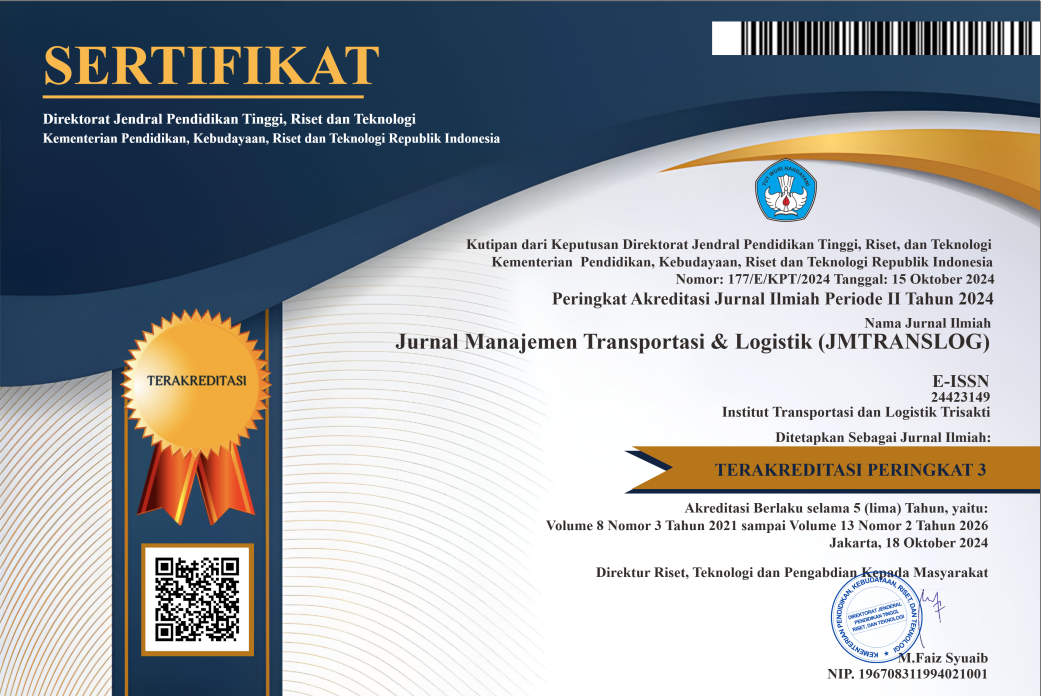

Jurnal Manajemen Transportasi & Logistik (JMTRANSLOG)
Published by : Pascasarjana Manajemen Transportasi, Institut Transportasi dan Logistik Trisakti
Address: JI. Jend.A.Yani Kav.85 Rawasari, Jakarta Timur, Provinsi DKI Jakarta, 13210
Phone: +62 8128245341
e-mail: jmtranslog.itltrisakti@gmail.com

This work is licensed under a Creative Commons Attribution-NonCommercial 4.0 International License.
