
Additional Menu

Jurnal Manajemen Transportasi & Logistik (JMTRANSLOG) is committed to maintaining the integrity, accuracy, and reliability of the scholarly record. The journal takes credible allegations of research or publication misconduct seriously, whether they concern submitted manuscripts, accepted articles, published articles, or the editorial and peer-review process.
Concerns may be raised by authors, reviewers, readers, research collaborators, institutions, or other individuals with relevant information. The journal assesses allegations based on their substance and supporting evidence rather than on the identity or status of the person reporting them.
Research or publication misconduct may include, but is not limited to:
Transportation and logistics studies may involve proprietary operational data, business records, financial information, passenger or customer data, employee information, or other confidential materials. Authors must ensure that they have appropriate authorization to access and use such information and that relevant privacy, confidentiality, and legal requirements are respected.
Where required, authors should explain how confidentiality was protected, how data were obtained, and whether permissions or ethical approvals were necessary. The journal may request clarification or supporting documentation when concerns arise.
Individuals who wish to report suspected misconduct should contact the editorial office through the journal's official contact channels. Reports should identify the relevant manuscript or article, describe the concern clearly, and provide supporting evidence where possible.
Anonymous reports may be considered when they contain sufficiently specific and verifiable information. However, the journal may be unable to proceed when an allegation lacks adequate detail or supporting evidence.
The editorial team will conduct an initial assessment to determine whether the concern is relevant, credible, and supported by sufficient information to justify further inquiry. The journal may request explanations from the authors, examine available research records, seek independent expert advice, or consult the relevant institution or organization.
Where an institutional investigation is appropriate, the journal may contact the responsible institution and request clarification or information about the outcome. The journal may pause editorial processing or take other proportionate interim measures while a significant concern is assessed.
The journal will seek to handle allegations fairly and confidentially, give relevant parties a reasonable opportunity to provide information, and avoid premature conclusions. Individuals involved in the assessment must disclose relevant conflicts of interest.
Depending on the evidence, the seriousness of the concern, and its impact on the manuscript or published findings, the journal may:
An allegation alone does not establish misconduct. Editorial action must be proportionate to the evidence and the potential impact on the reliability of the research. The journal will consider the seriousness of the issue, the available evidence, the explanations provided, and the need to protect the scholarly record.
The objective of this policy is to ensure that credible concerns are handled responsibly, that the rights of relevant parties are respected, and that published research remains as accurate and trustworthy as possible.
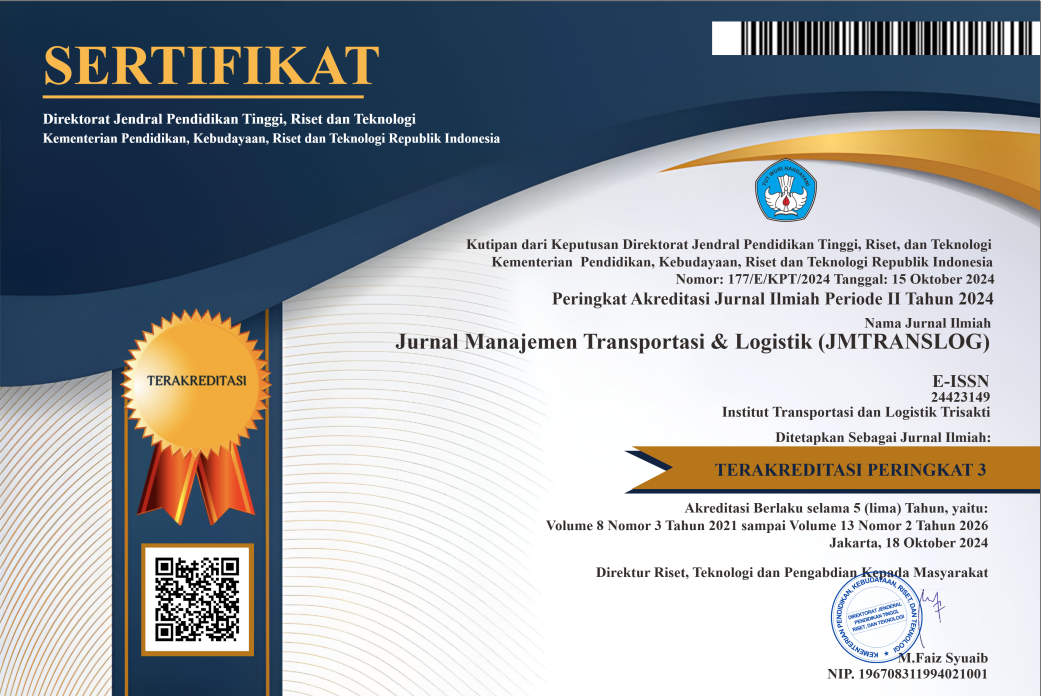

Jurnal Manajemen Transportasi & Logistik (JMTRANSLOG)
Published by : Pascasarjana Manajemen Transportasi, Institut Transportasi dan Logistik Trisakti
Address: JI. Jend.A.Yani Kav.85 Rawasari, Jakarta Timur, Provinsi DKI Jakarta, 13210
Phone: +62 8128245341
e-mail: jmtranslog.itltrisakti@gmail.com

This work is licensed under a Creative Commons Attribution-NonCommercial 4.0 International License.
