
Additional Menu

Jurnal Manajemen Transportasi & Logistik (JMTRANSLOG) aims to disseminate original scientific research, scholarly analyses, and evidence-based insights in transportation and logistics management. The journal promotes the development of knowledge, innovation, and effective management practices that contribute to the improvement of transportation systems, logistics operations, supply chain performance, and public transportation development.
JMTRANSLOG provides a scholarly forum for researchers, academics, practitioners, policymakers, and other professionals to share research findings and discuss contemporary challenges in transportation and logistics. It encourages research that advances theoretical understanding, improves managerial and operational performance, and provides practical or policy recommendations for sustainable and efficient transportation and logistics systems.
JMTRANSLOG welcomes original research articles based on field research, literature studies, and public policy research. Contributions may adopt macro or micro perspectives and may examine transportation and logistics issues through operational, production, human resource, marketing, consumer service, financial, and strategic management approaches.
The journal's scope includes, but is not limited to, the following areas:
JMTRANSLOG also welcomes studies that investigate transportation and logistics issues from operational, production, human resource management, marketing, consumer service, financial, and strategic management perspectives. Research may address organizational, regional, national, or broader transportation and logistics systems, provided that the subject is relevant to the journal's core focus.
The journal particularly encourages manuscripts that demonstrate sound research methods, clear analytical reasoning, relevant theoretical foundations, and meaningful contributions to transportation and logistics knowledge, management practices, or public policy.
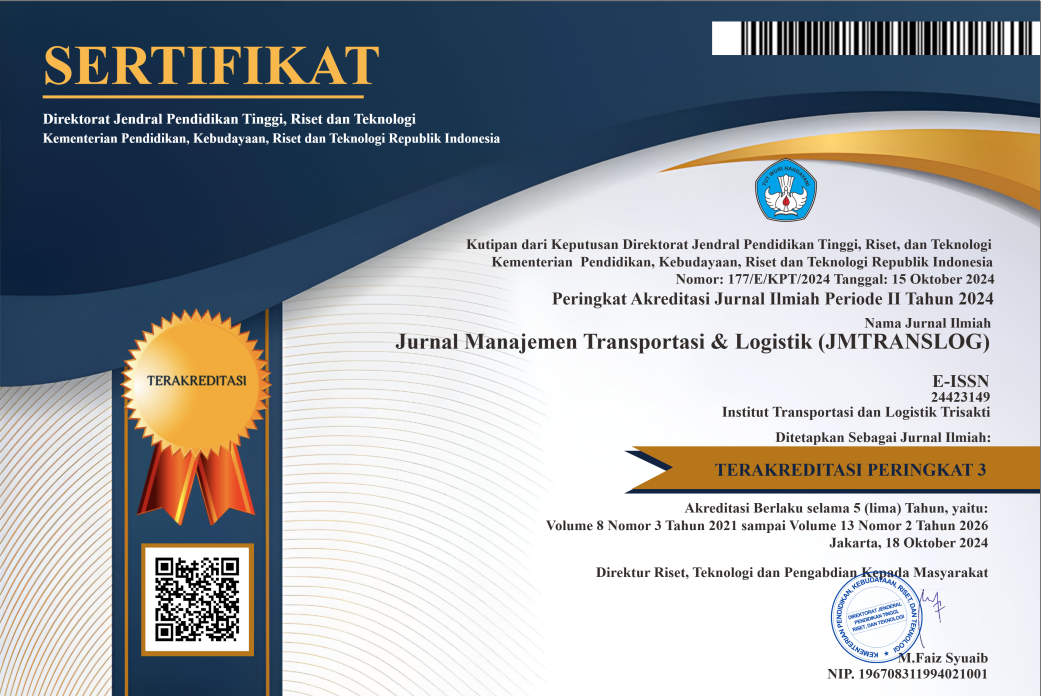

Jurnal Manajemen Transportasi & Logistik (JMTRANSLOG)
Published by : Pascasarjana Manajemen Transportasi, Institut Transportasi dan Logistik Trisakti
Address: JI. Jend.A.Yani Kav.85 Rawasari, Jakarta Timur, Provinsi DKI Jakarta, 13210
Phone: +62 8128245341
e-mail: jmtranslog.itltrisakti@gmail.com

This work is licensed under a Creative Commons Attribution-NonCommercial 4.0 International License.
